When to Hike Devils Bridge
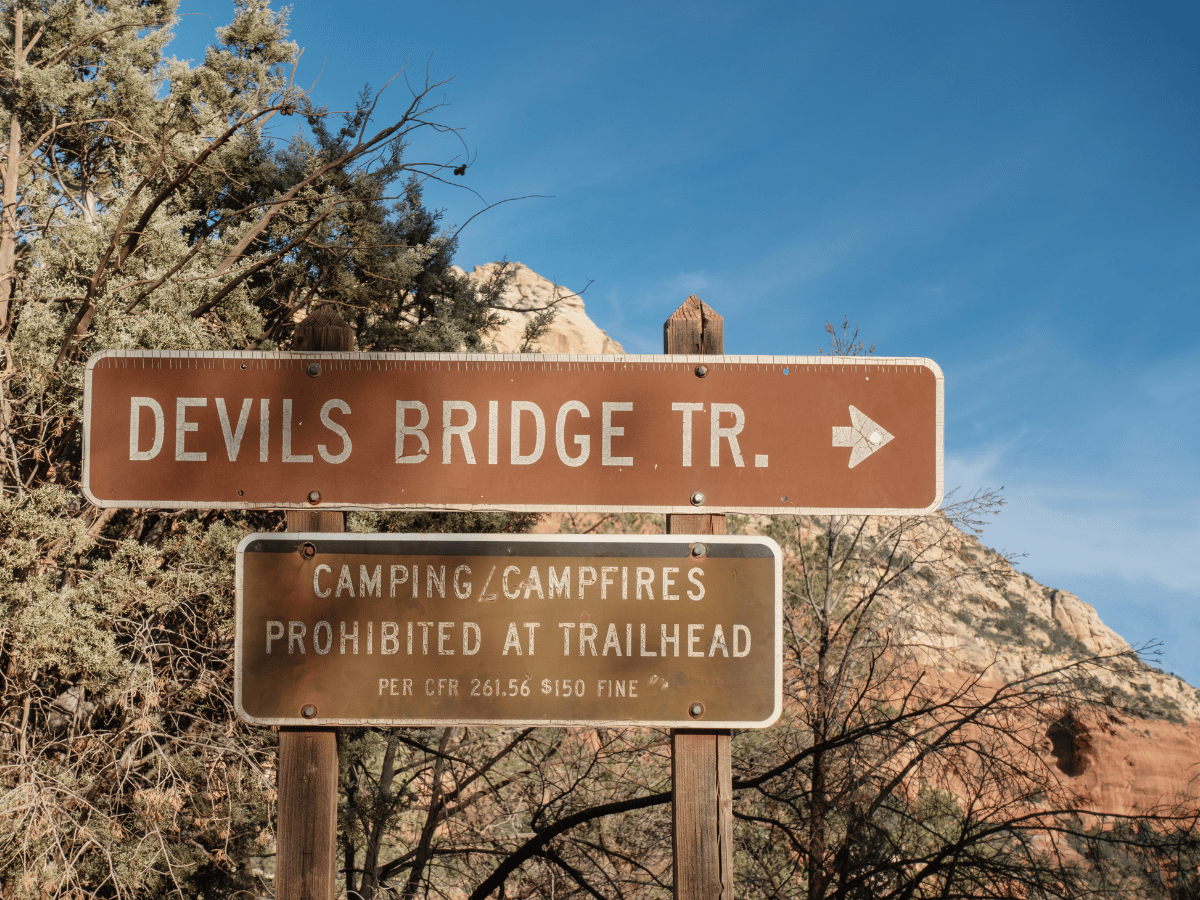
Devils Bridge is the largest natural sandstone arch in the Sedona area — 54 feet tall, with views that justify every step of the hike. It’s also one of Sedona’s most crowded trails, which means when you go matters almost as much as going at all.
The best time to hike Devils Bridge Sedona comes down to three things: season, time of day, and day of the week. Get those right and you’ll dodge the worst crowds, hike in comfortable weather, and actually enjoy the bridge instead of standing in line for an hour. Here’s what you need to know.
The trail at a glance
The hike itself is straightforward. From the Devils Bridge Trailhead (accessible only with a high-clearance 4WD vehicle), it’s about 2 miles round trip with roughly 400 feet of elevation gain. Without a 4×4, you’ll start from either the Mescal Trailhead (4.2 miles round trip) or the Dry Creek Vista Trailhead (4.6 miles round trip). Most of the added distance is flat walking along a dusty dirt road — not especially scenic, but easy.
The final stretch is where it gets interesting: steep rock steps, a bit of scrambling, and then the bridge itself. The whole thing takes one to three hours depending on your starting point, pace, and how long you wait in line for a photo on top of the arch.
You’ll need a Red Rock Pass to park at any of the trailheads — $5 for a day, $15 for a week, or $20 for a year. An America the Beautiful pass works too. You can buy passes at kiosk machines at the trailheads or online at Recreation.gov.
Best months: March through May and September through November
Spring and fall are the sweet spot. Daytime temperatures sit in the 60s to 80s°F — warm enough to be comfortable, cool enough that you’re not draining your water supply on the flat approach.
Spring (March–May) brings wildflowers and green desert scrub against the red rock. Fall (September–November) shifts the palette to warmer tones. Both seasons have clear skies more often than not, which matters when the whole point is the view from the top.
Summer is doable but punishing. Temperatures regularly push past 100°F, the trail has almost no shade, and dehydration is a real risk — especially on the longer routes. If you go in summer, start at dawn and carry more water than you think you need.
Winter is mild compared to most of the country (highs in the 50s–60s), but occasional snow and ice can make the rock steps slippery and genuinely dangerous. Check conditions before you go.
Best time of day: before 7 a.m. or after 3 p.m.
This trail gets crowded. The parking lots at Dry Creek Vista and Mescal often fill by 7 a.m. on weekends and holidays. Between 10 a.m. and 3 p.m., expect a line at the top — people wait their turn for photos on the bridge, and waits of 30 to 60 minutes are common during peak season.
An early start solves multiple problems at once. You get parking, you beat the crowds, and you hike in cooler temperatures. Arriving at the trailhead by 6 a.m. is not overkill.
Late afternoon is the other option. Crowds thin after 3 p.m., and the light on the red rocks gets dramatically better for photography. The tradeoff: you’re hiking back as the sun drops, so bring a headlamp just in case.
Weekdays vs. weekends
Weekdays are noticeably less crowded, especially Tuesday through Thursday. If you have any flexibility in your schedule, a midweek hike is the single easiest way to improve the experience. Weekend mornings in peak season can feel more like a queue than a trail.
The parking and access situation
This is the part most guides gloss over, and it’s the part that frustrates people the most.
With a 4WD high-clearance vehicle: You can drive down the unpaved section of Dry Creek Road (FR 152) about 1.3 miles past the paved lot to a small parking area right at the Devils Bridge Trailhead. The road is rough — deep ruts, large rocks, not for standard cars or rental sedans. This cuts your hike to 2 miles round trip. The lot holds about 12 cars and fills up by midmorning.
Without a 4WD: You have two options. The Mescal Trailhead (off Long Canyon Road) is the better one — it’s a more scenic 4.2-mile round trip that follows singletrack trail through desert terrain before connecting to the Devils Bridge Trail. The Dry Creek Vista Trailhead adds distance (4.6 miles round trip) and most of the extra walking is on the dirt road alongside passing Jeeps and ATVs.
The free Sedona Shuttle runs Thursday through Sunday (roughly 7 a.m. to 5:30 p.m.) and serves both the Mescal and Dry Creek Vista trailheads. Park at a designated Park & Ride lot for free, skip the parking headache entirely, and no Red Rock Pass needed. During spring break and holidays, the shuttle may run daily.
What to bring
This isn’t a backcountry expedition, but people underestimate it. The trail is exposed with very little shade.
Carry at least 1–2 liters of water per person (more in summer). Wear closed-toe shoes with decent traction — the rock steps near the top are uneven and can be slick. Sunscreen, a hat, and sunglasses are essential year-round. Layers are smart in spring and fall, when mornings can be cool and afternoons warm. A headlamp if you’re starting early or finishing late. Cell service is weak to nonexistent on the trail.
The photo line — what to expect
Walking across the top of Devils Bridge is the highlight, and everyone wants the shot. During busy periods, there’s an informal queue. People are generally patient and take turns, but budget 30–60 minutes of waiting time during peak hours in peak season. If the photo is important to you, the early morning or late afternoon windows are worth the effort — fewer people, better light.
If you’d rather skip the line entirely, there’s a viewpoint below the bridge (reached via a short side trail marked by a cairn) that gives you the classic wide-angle shot of the arch. Late afternoon light is best from this angle.
The bottom line
Go in spring or fall. Start early — ideally before 7 a.m. Pick a weekday if you can. Use the Mescal Trailhead or the shuttle. Bring water and sun protection. That’s it. The hike is manageable for most people, the payoff is genuinely impressive, and a little planning around timing turns a congested tourist stop into something you’ll actually remember.