Crispy Same Day Sourdough Discard Waffles
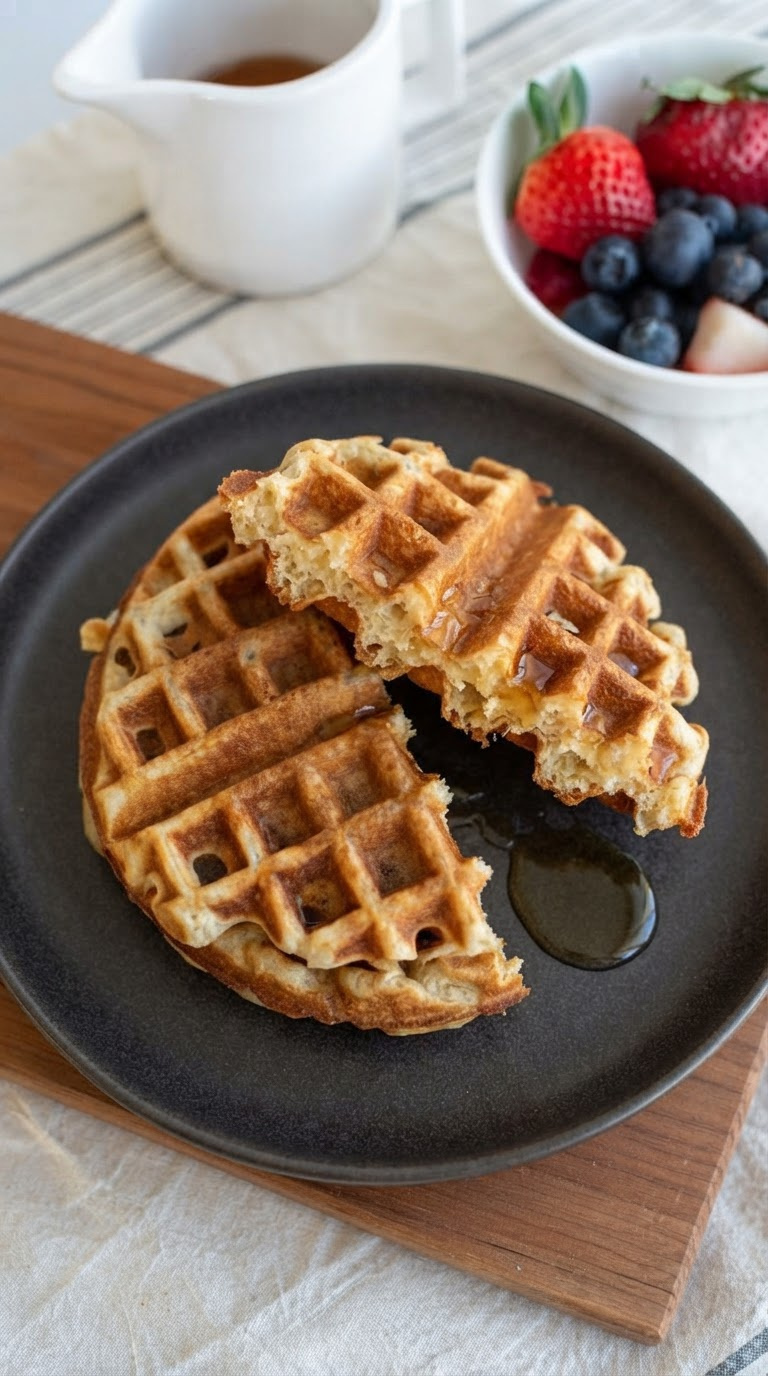
These sourdough discard waffles go from the jar to the iron the same day, with no overnight sponge, and they come out with a shell that stays crisp after they cool.
The crispness comes from three things: the discard, which is acidic, already-hydrated flour that browns fast and gives the baking soda something to react with; ¼ cup of cornstarch, which has no gluten and bakes into a thin, brittle crust; and oil instead of melted butter, which stays liquid as the waffle cools so the surface does not soften.
Six Belgian waffles take about 30 minutes start to finish.
WANT TO SAVE THIS FOR LATER?
We'll email it to you!
We won't send you spam. Unsubscribe at any time.
Why You’ll Love It
- No overnight ferment, batter mixed in 10 minutes
- Uses 1 cup of discard straight from the fridge
- Cornstarch and oil for a crust that stays crisp
- Makes 6 Belgian waffles
- Freezes and re-toasts well
- One bowl and a whisk, no mixer
Ingredients
This makes about 6 Belgian waffles at ½ cup of batter each.
1 cup (230 g) sourdough discard, unfed, straight from the fridge
1¼ cups (300 ml) buttermilk
2 large eggs
⅓ cup (75 ml) neutral oil, such as avocado or vegetable
1 teaspoon vanilla extract
1 cup (125 g) all-purpose flour
¼ cup (30 g) cornstarch
2 tablespoons granulated sugar
1 teaspoon baking powder
¾ teaspoon baking soda
¾ teaspoon kosher salt
Cooking spray for the iron
Steps
1. Plug in a Belgian waffle maker and set it to medium-high, about 4 out of 5; it takes 5 to 8 minutes to heat fully, and a hot iron is half of the crispness.
2. Set a wire cooling rack on the counter, or on a sheet pan in a 200°F (95°C) oven if you want to hold the whole batch and eat together.
3. In a large bowl, use a balloon whisk to whisk the discard, buttermilk, eggs, oil, and vanilla for about a minute until there are no thick streaks of discard left; it starts out lumpy and smooths out.
4. In a second bowl, whisk the flour, cornstarch, sugar, baking powder, baking soda, and salt so the baking soda is spread evenly and does not leave bitter pockets.
5. Add the dry mix to the wet and whisk just until there are no dry patches, 20 to 30 seconds; small lumps are fine, and whisking until smooth makes the waffles tough.
6. The batter starts bubbling within a minute as the baking soda meets the acid in the discard and buttermilk; let it rest 5 to 10 minutes while the iron finishes heating, and it will thicken a little.
7. Spray the iron, pour ½ cup of batter per waffle from a batter bowl with a spout, close the lid, and cook 4 to 5 minutes until the steam slows to almost nothing and the waffle is deep golden.
8. Do not open the iron before 3 minutes or the top will tear away from the bottom; if the first waffle comes out pale, raise the setting one notch, since the first one is always the test.
9. Lift the waffle onto the rack with a fork and never stack them warm; steam trapped between two waffles softens the crust in about 30 seconds.
10. Close the iron and wait 30 to 60 seconds before pouring the next one so it gets back up to temperature.
11. Serve warm from the rack with butter and maple syrup.
Helpful Tips & Substitutions
Discard up to 2 weeks old from the fridge works, and older discard is more sour, which reads as flavor here rather than a problem.
The recipe assumes a 100% hydration starter, equal weights of flour and water; if yours is stiffer, add 2 tablespoons more buttermilk, and if it is very loose, hold back 2 tablespoons.
Cornstarch swaps a quarter of the flour’s gluten for pure starch, which means less chew and more crisp; arrowroot works 1:1, and leaving it out gives you a softer, breadier waffle.
Melted butter tastes richer than oil but firms up as the waffle cools and the surface goes soft with it; if you want butter flavor, brush the finished waffle with melted butter instead of putting it in the batter.
The ¾ teaspoon of baking soda is matched to the acid in the discard plus buttermilk; if you swap the buttermilk for regular milk, cut the soda to ¼ teaspoon and stir 1 tablespoon of lemon juice into the milk, or the waffles taste soapy and brown too dark.
The 2 tablespoons of sugar are there for browning more than sweetness; more sugar means darker waffles faster, so drop the iron setting a notch if you add it.
For a standard round waffle iron, use ⅓ cup of batter and 3 to 4 minutes, which makes about 9 waffles.
Weighing the discard and flour on a digital kitchen scale matters, because a cup of discard can swing by 50 grams depending on how bubbly it is.
Serving Ideas
Butter, warm maple syrup, and a handful of berries is the standard plate.
For a weekend breakfast where everything lands at once, put a tray of Sausage Sheet Pan Scrambled Eggs in the oven; it finishes in the time it takes to cook the waffles.
Cut into quarters, these work on a Pancake Charcuterie Board next to the pancakes, with the same bowls of fruit, syrup, and whipped cream.
For a savory version, skip the sugar and vanilla, fold ½ cup of shredded sharp cheddar into the batter, and top the waffle with a fried egg.
A waffle sandwich with a square of the sheet pan eggs and a slice of cheese in the middle travels in a napkin.
Make-Ahead & Storage
Cool the waffles completely on the rack before storing; warm waffles in a bag steam themselves soft.
Refrigerate in an airtight container for up to 3 days and re-crisp in the toaster, never the microwave, which makes them floppy.
To freeze, layer them with parchment in a freezer bag for up to 3 months.
Reheat from frozen in the toaster for 2 cycles on medium, or in a 400°F (200°C) oven or air fryer for 4 to 5 minutes, until the edges crackle again.
The batter does not hold, because the baking soda reacts the moment it hits the acid; after an hour it has gone flat and the waffles come out dense.
To get ahead, whisk the dry ingredients into a lidded jar the night before and mix the wet in the morning.
The first waffle out of the iron is softer than the rest because the iron has not recovered its heat yet.
Give it that minute between waffles and the third and fourth are the ones that crack when you cut them.
WANT TO SAVE THIS FOR LATER?
We'll email it to you!
We won't send you spam. Unsubscribe at any time.